
The Natural Channel Is Everywhere Now. Is Your Brand Ready for It?
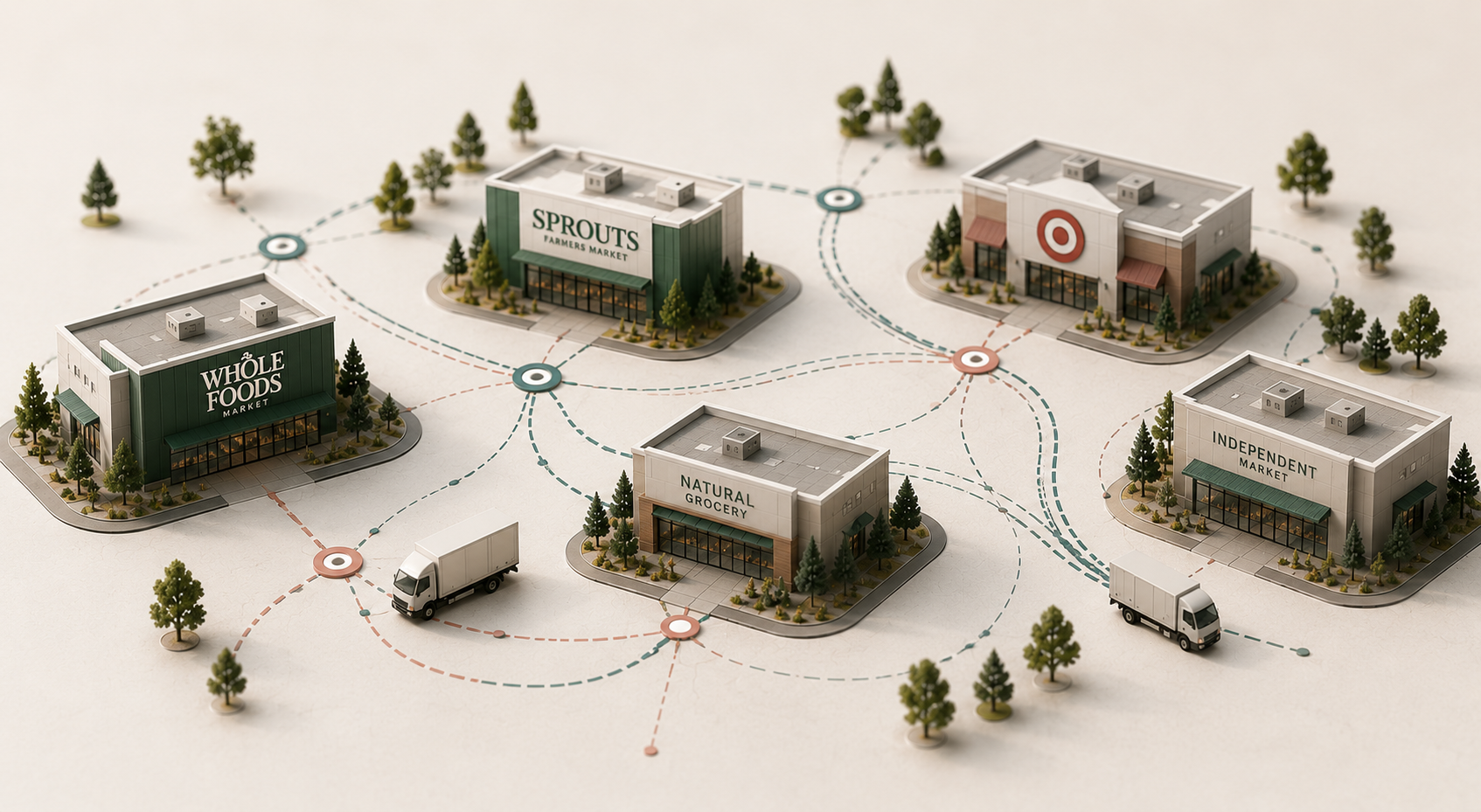
The line between the natural channel and the conventional channel is getting harder to draw. Consumer behavior is shifting. Retailers that once served distinct audiences now compete for the same shopper. And the distribution landscape is moving faster than most brands can keep up with.
Sprouts Farmers Market added 37 stores in its last fiscal year, bringing its total to over 440 locations. Another 40+ stores are planned for 2026. For natural brands, this is not just one retailer growing. It is a signal about where the entire channel is headed, and what it takes to be positioned when the doors open.
This is not a niche trend. It is an accelerating channel shift. The brands that capture it will be the ones whose distribution strategy matches the pace of expansion.
The Natural Channel Is Expanding, And the Competitive Landscape Is Shifting
Sprouts is the headline, but the story is bigger than one retailer. The natural channel as a whole is gaining share: more square footage, more consumer traffic, and more scrutiny from buyers who expect brands to prove performance, not just authorization.
| Metric | Data Point |
|---|---|
| Natural channel sales share vs. footprint | 4.92% of space generates 10.29% of sales ($115.8B) |
| Sprouts new stores (last fiscal year) | 37 stores added |
| Sprouts planned openings (2026) | 40+ additional stores |
| WFM-Sprouts shopper overlap | 33% (up from 29% in 2024) |
| Whole Foods new stores (same period) | 7 stores |
The overlap between Sprouts and Whole Foods shoppers is increasing, now at 33%, up from 29% two years ago. Natural brands are competing for the same consumer across multiple retailers. Distribution strategy has to account for how these channels interact rather than treating each retailer in isolation.
For brands already in the natural channel, more doors means more opportunity. But more doors also means more operational complexity: more distributor coordination, more shelf space to manage, and more data to track.
What Channel Expansion Means for Natural Brands
When a retailer like Sprouts adds dozens of stores in a single year, it changes every part of a brand's commercial operation. Here is what shifts, and where most brands get caught off guard.
Distribution Becomes an Operations Discipline
At 10 or 20 doors, distribution can be managed reactively. At 200+ doors across multiple regions, it cannot. Every new store opening is a coordination event: confirming product availability at the right distribution center, ensuring shelf placement happens within the first ordering cycle, and tracking whether the product actually made it to the shelf.
Brands that treat distribution as a sales function will fall behind. The ones that treat it as an operations discipline, with systems, tracking, and accountability, will capture the expansion.
Velocity Data Becomes the Currency
Buyers at expanding retailers are watching velocity data more closely than ever. Authorization alone does not guarantee continued shelf space. Brands need to demonstrate sell-through. Not just that the product shipped to the store, but that it moved off the shelf at a rate that justifies the space.
This requires reporting infrastructure that most brands under $10M do not have: monthly sell-through data by SKU, by retailer, by region. Without it, you are managing your distribution blind.
The Omnichannel Reality Changes How You Think About Your SKU Set
As natural brands expand into more doors and more channels, the pressure on your product lineup increases. Every SKU you carry has to justify its shelf space at scale. A lineup that works at 50 doors may not travel well across 300 doors in both natural and conventional retailers.
This means taking a hard look at your assortment. Which SKUs drive velocity across all channels? Which ones only perform in specific accounts? Simplifying your lineup and focusing on a clean, high-performing core set is often the most effective distribution strategy a brand can adopt.
Growth at Sprouts: Expansion or Performance?

Here is a question every brand in Sprouts should be asking: is your growth coming from new stores opening, or from stronger sell-through in existing locations?
Expansion growth means your sales went up because Sprouts opened new doors and your product was placed in them. Performance growth means your velocity improved in stores that were already carrying you. Both matter, but they tell very different stories about the health of your brand.
If your total sales at Sprouts are up 15% but the retailer added 10% more stores, the real question is what happened in the stores that already had your product. Track both numbers separately. It is the only way to know whether your brand is genuinely gaining traction or simply riding the retailer's expansion.
This is both an opportunity and a reality check. The brands that separate expansion growth from performance growth are the ones making smarter decisions about investment, education, and promotional spend.
The Education Layer Becomes a Differentiator

New stores mean new associates who do not know your brand. A product sitting on a shelf without store-level advocacy is just inventory waiting to be discontinued. Brands that invest in retail education, getting educators into stores to train associates on ingredients, differentiation, and selling points, consistently see stronger velocity in those locations.
This is especially true in the natural channel, where consumers ask more questions and rely more heavily on associate recommendations than in conventional grocery.
Worth knowing: The natural channel consumer shops differently. They read labels, ask questions, and trust store associates. Brands that invest in the education layer are not just training staff. They are building an in-store sales force that works on their behalf every day
Your SKU Set Has to Travel Well Across Channels
As distribution expands, the brands that perform best are the ones with a clean, focused core set. Not the brands with the longest lineup. A tight SKU set that moves consistently across natural, conventional, and online channels is a competitive advantage.
Simplicity is a strategy. If a SKU does not pull its weight in at least two channels, it is costing you shelf space, distributor bandwidth, and buyer patience. The brands scaling through this expansion are the ones making hard calls about what stays and what goes.
Pricing Architecture Has to Hold Across Channels
As natural brands expand distribution, they often find themselves selling into both natural and conventional channels. Sprouts, Whole Foods, and independent natural retailers all have different margin expectations. Without a pricing architecture that defines margin floors by channel and guardrails for promotional pricing, brands end up eroding margin one deal at a time.
Channel expansion without pricing discipline is growth that costs you money.
How to Position Your Brand for the Expansion
If your brand is in the natural channel, or planning to be, here is what to prioritize for the remainder of 2026:
→ Build distribution tracking infrastructure. Know exactly which doors carry your product, which doors are authorized but empty, and which new stores are opening in your regions. A simple tracking system is better than none. A structured program with distributor coordination is where you want to be.
→ Invest in sell-through reporting. Move from monthly sales summaries to monthly velocity data by SKU and retailer. This is the data your buyers are already looking at. You should be looking at it first.
→ Align your broker priorities to expansion regions. If your broker network covers regions where Sprouts or other natural retailers are opening new stores, make sure they are focused on getting your product on the shelf in those doors. Not just managing existing relationships.
→ Schedule education for new doors. New stores have new associates. Getting educators into those locations in the first 60 days builds product confidence at the shelf level, which directly impacts velocity.
→ Review your pricing across channels. Make sure your margin structure holds across natural and conventional. If you are winning doors but losing margin, the growth is not sustainable.
→ Separate expansion growth from performance growth. Track new-store revenue separately from same-store velocity. This is the only way to know whether your brand is gaining real traction or riding retailer growth.
Omnichannel is not about being everywhere. It is about being ready everywhere you are. The brands that win the next phase of natural channel growth will be the ones with the operational infrastructure to support every door they are in.
Take the Revenue Architecture Self-Assessment
See where your gaps are before the next wave of expansion.
Frequently Asked Questions
How many Sprouts stores are opening in 2026?
Sprouts Farmers Market added 37 stores in its last fiscal year. The company has announced plans for 40+ additional stores in 2026, continuing its position as one of the fastest-growing natural channel retailers in the U.S.
What does channel expansion mean for natural brands?
Channel expansion means more retail doors opening in the natural channel, creating both opportunity and operational complexity. For brands already authorized in expanding retailers, each new store is a revenue opportunity that requires distribution coordination, velocity tracking, and often education support to capture effectively.
How should natural brands prepare for retail expansion?
Start with distribution tracking infrastructure so you know which doors carry your product and where gaps exist. Invest in monthly sell-through reporting to demonstrate velocity to buyers. Align broker priorities to expansion regions. And schedule education visits for new stores in the first 60 days.
What is the difference between natural and conventional channel strategy?
Natural channel consumers shop differently. They read labels, ask questions, and rely on associate recommendations. Distribution in the natural channel also tends to be more concentrated through distributors like KeHE and UNFI. Pricing, education, and promotional strategy all need to be tailored to the channel rather than applying conventional grocery playbooks.
How do I know if my brand is growing because of expansion or performance?
Track new-store revenue separately from same-store velocity. If your total sales at a retailer are up 15% but the retailer added 10% more stores, your real growth may only be 5%. Separating these numbers is the only way to know whether your brand is gaining genuine traction or simply riding the retailer's footprint growth. Brands scaling past $3M to $5M in revenue that are managing distribution reactively, without structured tracking, distributor scorecards, or velocity reporting, are strong candidates for dedicated commercial leadership support.
Position Your Brand for the Natural Channel Expansion
Beyond Business provides fractional executive leadership that installs the commercial infrastructure natural brands need to scale distribution sustainably.
<< Back to Beyond Business Blog