

The promotion ran last month. The charges tied to it are landing this month, or next. If you were not tracking it while it was happening, the check you get this month is going to be smaller than you expected, and you will not know why until you go digging.
This is one of the most common blind spots between distributor management and AR. Not the promotion itself, but everything that happens after the promotion runs, on a different calendar than the one the brand is watching. Most brands plan the discount carefully, confirm the dates, coordinate with the distributor. Then the promotion ends, the team moves on, and the deduction that follows lands weeks or months later in a different reporting period, often coded in a way that makes it hard to trace back to the original promotion.
If this cycle sounds familiar, it is not because your team is dropping the ball. It is because the way promotions and deductions are structured in the natural channel creates a built-in lag that most brands are not set up to manage proactively.

The Timing Lag Most Brands Ignore
Promotions run in one month. The charges tied to them, MCBs, OI fees, admin fees, often do not show up as deductions until the following month, sometimes later. If you do not know which month a charge is going to hit, you cannot reconcile it when it does. You just see a smaller check and start reverse-engineering what happened.
Key insight: The brands that manage this well are not reacting faster. They know, before the promotion even runs, roughly when the charge will land and roughly how much it will be. Everyone else finds out when the money is already gone.
This is not a minor operational detail. For brands running multiple promotions across multiple retailers in the same quarter, the lag can create real cash flow confusion. September promotions generate October deductions, which overlap with October's own promotional charges. By the time the Q4 push starts, nobody is sure which charges belong to which promotions.
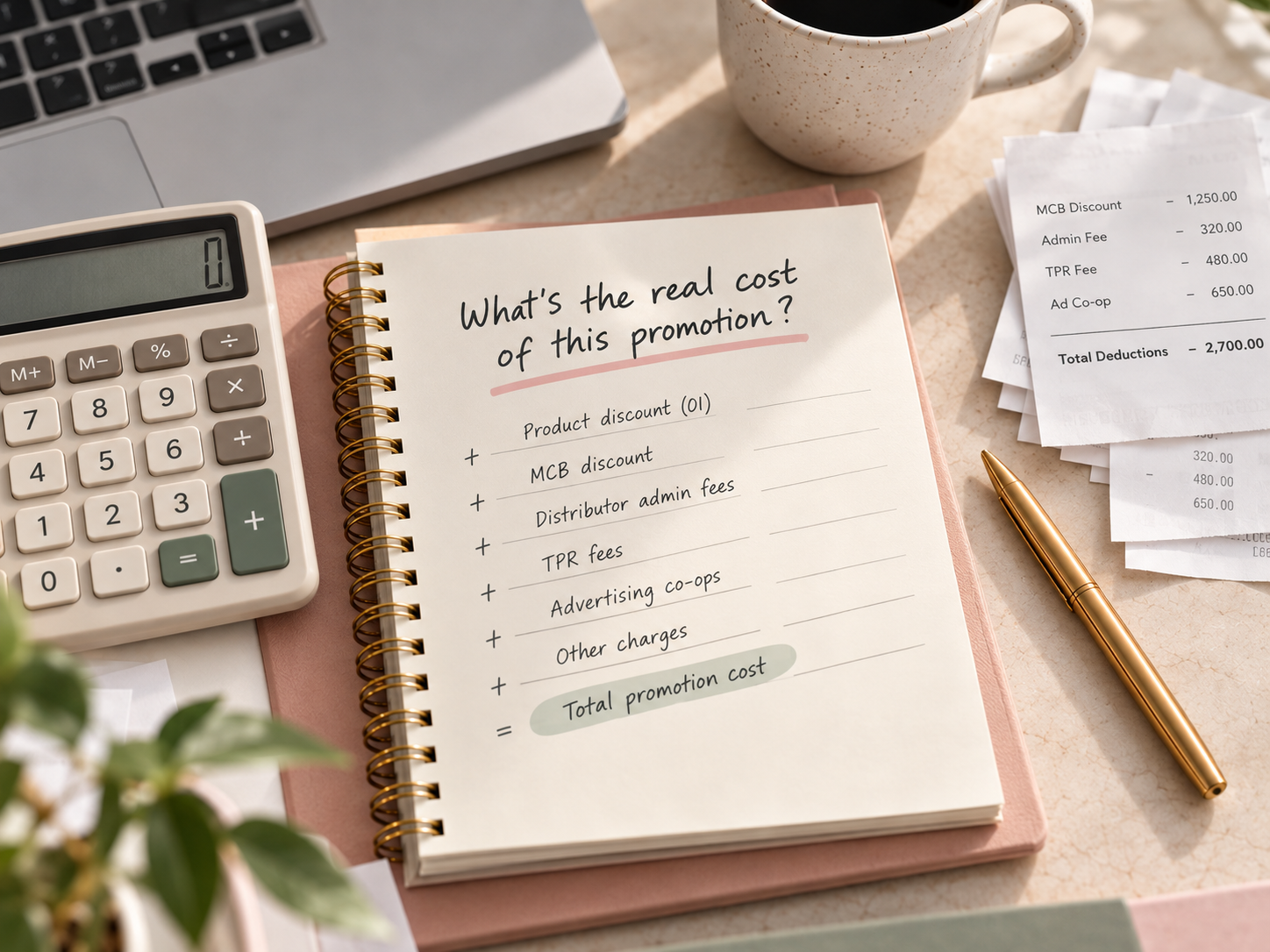
The Real Cost of Running a Promotion
"We ran a 15% OI promotion with an additional 5% MCB" sounds like a complete picture. It is not.
Before you can evaluate whether a promotion was worth running, you need to answer a series of questions that most brands skip. What additional charges come with the MCB itself? Admin fees are usually layered on top, and they vary by distributor. How often is that fee applied? A biweekly admin fee on a six-week promotion costs significantly more than the same fee on a two-week run.
Was the promotion worth running in every account where it was offered? A discount that makes strategic sense at one retailer does not automatically make sense everywhere it is available. Did you forecast the total spend before you committed? That means knowing the MCB cost, the admin fees, and the incremental sales you expected, before it started. Not after.
Did the promotion meet that forecast? Not "did we sell more," but did you sell enough more to justify the full cost? Once you add TPR fees, advertising co-ops, and every other charge tied to the promotion, did you actually make money, or did the promotion pay for itself and nothing else?
None of these questions get answered after the fact. They get answered by having the forecast and the cost structure in place before the promotion runs.
Accrual vs. Surprise
There is a meaningful difference between brands that see deductions coming and brands that get surprised by them.
Accruing for promotional expense as it is committed, not when the invoice clears, means the deduction is expected when it lands. The check is smaller, yes, but the number matches what was planned. Brands that do not accrue are effectively finding out their real margin after the fact, every single cycle.
Worth knowing: Accrual is not just a finance exercise. It is what turns "why did we get less than expected" into "yes, that is the number we planned for." When your sales team, your finance team, and your leadership are all working from the same expected number, the conversation shifts from reactive confusion to proactive planning.

The Structural Gap Between Sales and Finance
This is where most brands between $5M and $20M in revenue get stuck.
Sales builds the promotional calendar. Their goal is velocity, shelf placement, endcaps, keeping retail buyers engaged. Finance processes the deductions, codes them, reconciles against the invoice. Their goal is accuracy and cash management.
Notice what is missing: nobody is connecting the promotional spend to actual sell-through performance. Sales knows what promotions ran. Finance knows what deductions came in. Neither team is asking the critical question: did this promotion generate enough incremental volume to justify the cost?
This is not a failure of either team. It is a structural gap. Promotional ROI falls in the space between both departments, and unless someone is specifically assigned to close that loop, it stays open. At Beyond Business, this is exactly the kind of gap we help brands identify. Not by managing deductions, but by analyzing the data from the sales side. We connect promotional activity to sell-through performance so brands can see whether their trade spend is generating real returns or just funding discounts.
Clean Data In, Clean Answers Out

None of the analysis above works if the spend and charges were not entered correctly in the first place.
If you do not enter the promotion, the MCB, the admin fees, and the expected deduction accurately at the time they are committed, it becomes very difficult to track performance later. The reconciliation does not fail in October. It fails in September, at the point of entry. A promotion that was entered with the wrong dates, the wrong fee structure, or an incomplete cost breakdown will produce bad data no matter how good your reporting is downstream.
The same principle applies to GL codes. Too few GL codes and everything gets lumped together. You can see that money went out, but not which promotion or charge type drove it. Too many codes, and entries get miscoded because nobody applies them consistently. The right number of GL codes is the number your team will actually use the same way, every time. If your team has 40 GL codes for trade spend but only uses 8 of them correctly, you effectively have 8 GL codes and 32 sources of error.
The Fix Is Not Reacting Faster
The solution to the promotion-to-deduction cycle is not better forensics after the fact. It is building the tracking habit upstream, in the month the promotion actually runs, not the month the deduction shows up.
→ Forecast the full cost before you commit. Know the MCB, the admin fees, the discount rate, and the incremental volume you need to break even.
→ Accrue for it as soon as it is committed. Do not wait for the invoice. Book the expected expense when you agree to the promotion.
→ Enter it correctly the first time. Right dates, right fee structure, right cost breakdown. Bad data in September means bad answers in October.
→ Code it consistently. Use GL codes your team actually understands and applies the same way every time.
→ Measure it after. Compare sell-through against baseline, total cost against incremental revenue, and post-promo velocity against pre-promo velocity.
Download the Promotional Planning and Measurement Worksheet
Plan promotions with the full cost structure visible. Measure sell-through against deductions to see if you came out ahead. Not accounting. Sales intelligence.
Do that, and October stops being the month your September promotions catch you off guard. It becomes the month you verify that the numbers landed where you expected them to.
Frequently Asked Questions
How do I know when a promotional deduction will actually hit?
The timing varies by distributor, but most promotional deductions land 30 to 60 days after the promotion ends. Some distributors process charges biweekly, others monthly. The key is to learn your distributor's specific billing cycle and build that lag into your forecasting. If you run a September promotion, assume the deduction will land in October or early November, and plan your cash flow accordingly. Over time, you will develop a reliable pattern for each distributor relationship.
What is the difference between managing deductions and analyzing them?
Managing deductions is an accounting function: receiving the invoice, coding the charge, reconciling it against the original purchase order, and disputing errors. Analyzing deductions is a sales function: connecting the charge back to the promotion that generated it, measuring whether the incremental volume justified the cost, and using that data to make better promotional decisions going forward. Both are necessary. At Beyond Business, we work on the analysis side. We help brands understand what their trade spend is actually producing from a sales and revenue perspective.
How many GL codes should I use for trade spend?
Enough to separate the major charge types (OI, MCB, admin fees, TPR, advertising co-ops) but few enough that your team applies them consistently. For most brands in the $5M to $20M range, 6 to 10 well-defined GL codes for selling expenses is a practical starting point. The goal is not granularity for its own sake. It is having categories that are meaningful, distinct, and consistently applied so you can actually track where the money is going.
Should I forecast promotional costs before committing to a promotion?
Always. A promotional forecast should include the direct discount (OI percentage), any MCB commitment, associated admin fees, the duration and frequency of those fees, and the incremental volume you expect the promotion to generate. Without a forecast, you have no way to evaluate whether the promotion was successful after it runs. "We sold more" is not a measurement. "We sold X more units at Y margin, which covered the Z total cost of the promotion" is a measurement.
What should I measure after a promotion ends?
Start with sell-through versus baseline: how did volume perform during the promotional period compared to the same SKUs in the same accounts without a promotion? Then look at post-promotional velocity: did volume return to baseline immediately, or did the promotion generate any lasting lift? Finally, calculate total cost versus incremental revenue. Add up every charge tied to the promotion (discount, MCB, admin fees, advertising, TPR) and compare it to the incremental revenue the promotion generated above baseline. That is your promotional ROI.
See If We’re a Fit
Beyond Business provides fractional executive and operational support to natural beauty, skincare, and wellness brands. We analyze promotional data from the sales side so brands can make smarter decisions about trade spend, distribution, and growth.
<< Back to Beyond Business Blog