
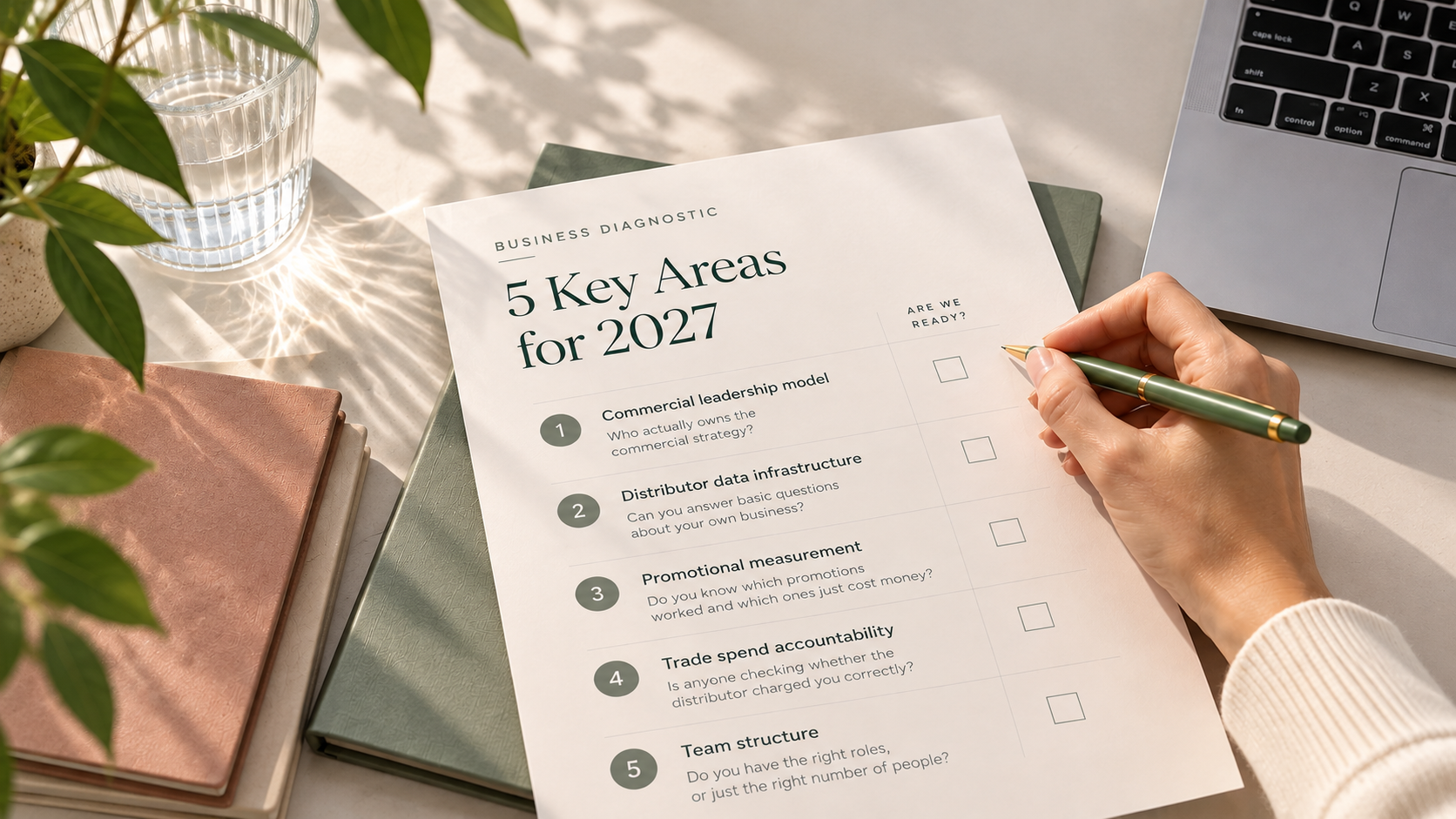
November is planning season. Every natural CPG brand is setting 2027 targets right now. Revenue goals. New product launches. Retail expansion lists. The usual.
Here is what most of those plans are missing: the infrastructure that determines whether any of it actually works.
Infrastructure is not a word that gets people excited in the beauty and wellness space. It is not as fun as a new SKU launch or a Sprouts reset. But if your distributor data is a mess in December, it will still be a mess in January. If nobody owns your commercial strategy today, that will not magically resolve itself on January 1.
We work inside natural beauty, skincare, and wellness brands at the $5M to $20M stage. The pattern is consistent. The brands that stumble in Q1 almost always trace it back to one of the same five infrastructure gaps. Not product problems. Not demand problems. Structural ones.
These are the five decisions to make before 2027.
Decision 1: Your Commercial Leadership Model

Who owns your commercial strategy? Not sales. Commercial strategy. The distributor relationships. The promotional calendar. The pricing architecture. The retail expansion plan.
At $5M to $20M in revenue, most brands cannot justify a full-time CRO or VP of Sales. The salary, benefits, and equity expectations for that role start around $250K all-in. For a brand doing $8M with thin margins, that is a heavy bet.
So the work gets split. The founder handles key accounts. The broker runs on autopilot with quarterly check-ins. An operations person reviews deductions when they have time. Nobody owns the whole picture.
This is the most common setup we see. It is also the one that produces the most Q1 chaos. When everyone owns sales, nobody owns commercial strategy.
The decision is straightforward. Do you fill this role full-time, fractional, or not at all? According to ForceBrands, 72% of CEOs in consumer products plan to increase their use of fractional executives. The model is not new. It is becoming standard.
A fractional commercial leader works inside your business 15 to 25 hours a week. They own the broker relationship, manage the distributor account, build the promotional calendar, and show up to buyer meetings. You get executive-level commercial leadership without the full-time cost.
If you are planning 2027 without a clear answer to "who owns our commercial strategy," that is your first decision.
KEY QUESTION
Can you name the single person responsible for your commercial strategy across all channels? If it takes more than one name, you have a gap.
Decision 2: Your Distributor Data Infrastructure

Here is a test. Can you answer these four questions about your business right now, without digging through email or asking your broker?
→ How many retail doors are you in?
→ What is your average velocity per store per week?
→ Which SKUs are declining quarter over quarter?
→ What is your fill rate at your primary distributor?
Most brands at this stage cannot answer those questions with confidence. The data exists. It lives in UNFI portals, KeHE reports, broker recaps, and retailer scorecards. But nobody has pulled it into one place where it tells a coherent story.
Instead, the data lives in disconnected spreadsheets. The broker sends a monthly recap that is three weeks old by the time anyone reads it. The distributor portal has real-time data, but nobody logs in consistently. The CEO gets a revenue number and a gut feeling.
This is not a technology problem. You do not need a $50K business intelligence platform. You need someone who pulls distributor data on a regular cadence, normalizes it, and turns it into decisions. Weekly velocity reports. Monthly door counts. Quarterly SKU rationalization reviews.
The decision: build a data system before 2027 starts, or spend another year making $5M to $20M decisions on $500K information.
Reality Check
If your last distributor data review was more than 30 days ago, you are already behind. Velocity shifts, out-of-stocks, and declining doors do not wait for quarterly reviews.
Decision 3: Your Promotional Measurement System
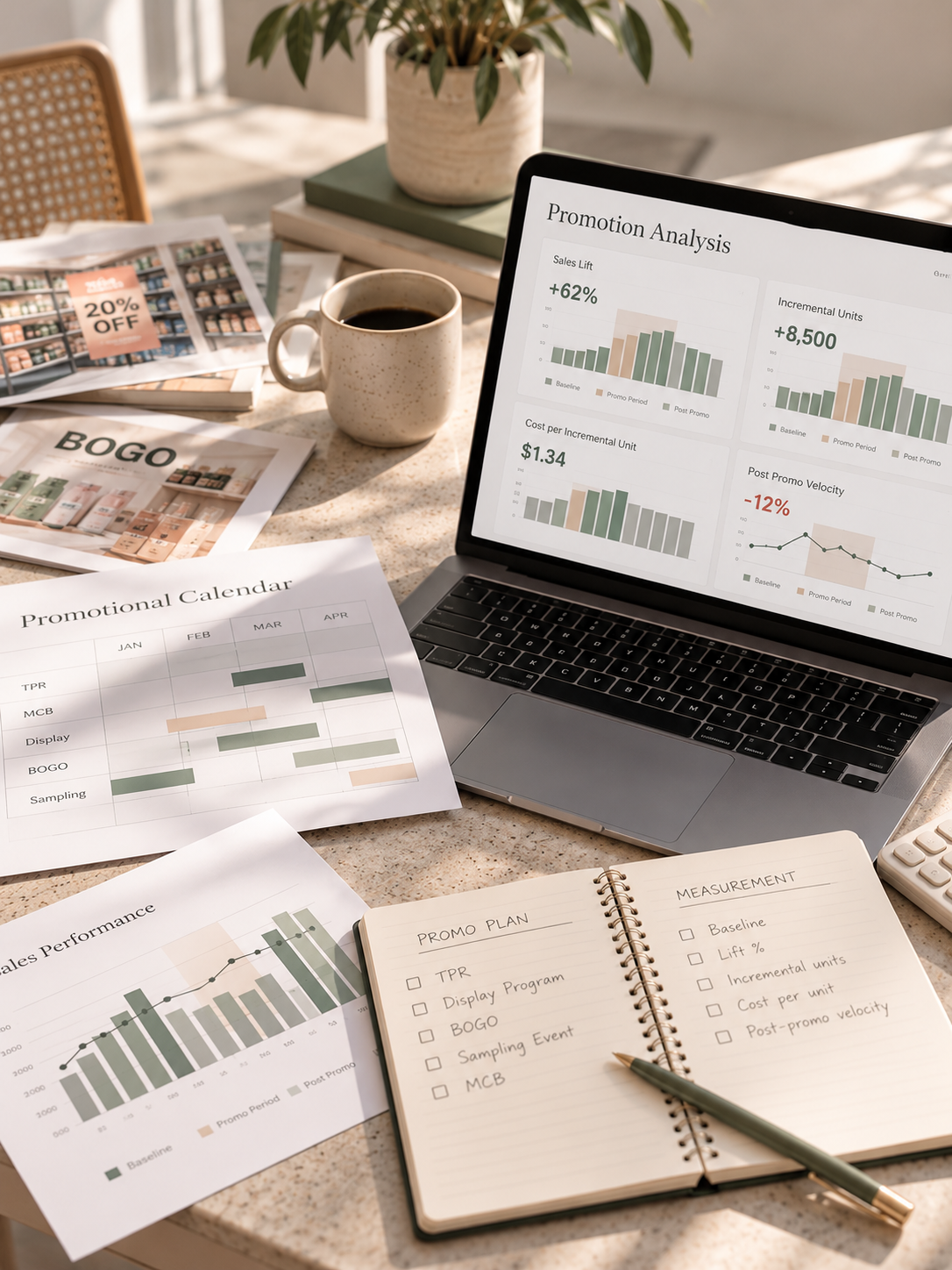
You ran promotions in 2026. Maybe a lot of them. TPRs, MCBs, display programs, BOGO offers, sampling events. The question is not whether you promoted. The question is whether you know what worked.
Not "felt good." Not "the buyer seemed happy." Actual measurement.
What was the lift on that Sprouts TPR in March? What was your cost per incremental unit? Did the promotion bring in new buyers, or did existing customers just stock up early? When the promo ended, did velocity return to baseline or drop below it?
Most brands spend somewhere between 15% and 25% of revenue on trade spend. For a $10M brand, that is $1.5M to $2.5M a year. That is serious money. And most cannot answer a single one of those questions with data.
The reason is simple. Promotional measurement requires before-and-after data at the store level. It requires a baseline velocity calculation. It requires someone to actually run the analysis after the promo ends. Most brands plan the promotion, execute it, and move on to the next one without ever closing the loop.
The decision: build measurement into your 2027 promotional calendar from the start. Define the baseline before the promo runs. Assign someone to pull post-promo data two weeks after it ends. Build a simple scorecard: lift percentage, cost per incremental unit, post-promo velocity trend.
Or keep spending blind. Your call.
Basic Promotional Measurement Framework
| Metric | When to Capture | Who Owns It |
|---|---|---|
| Baseline velocity (units/store/week) | 2 weeks before promo | Data analyst or broker |
| Promo velocity | During promo window | Distributor portal pull |
| Lift percentage | 1 week after promo ends | Commercial lead |
| Cost per incremental unit | 2 weeks after promo ends | Finance + commercial |
| Post-promo velocity trend | 4 weeks after promo ends | Commercial lead |
Decision 4: Your Trade Spend Accountability
This one is related to promotional measurement, but it is a distinct problem. Promotional measurement asks "did this work?" Trade spend accountability asks "did they charge us correctly?"
Distributors charge deductions. Some are authorized: the TPR you agreed to, the new item slotting fee, the MCB you negotiated. Some are not: expired deal windows that keep billing, pricing errors, unauthorized markdowns, duplicate charges.
At this stage, the person reviewing deductions is often nobody. The charges come off the top of your invoice payment. Accounting sees the net number. Finance reports revenue after deductions. The gap between what you authorized and what you were charged gets buried in the P&L.
We have seen brands lose 2% to 4% of gross revenue to deduction errors they never caught. On $10M in revenue, that is $200K to $400K a year.
The decision: assign ownership and a review cadence. Someone needs to look at deductions weekly or biweekly, compare them against authorized promotions, and flag discrepancies. This does not require a massive team. It requires one person with access to the distributor portal and a reconciliation spreadsheet.
If nobody is doing this today, start before January.
What to Look For
Expired deal windows still billing, pricing errors on new SKUs, duplicate promotional charges, and unauthorized markdowns. These four categories account for the majority of deduction errors.
Decision 5: Your Team Structure for Growth
This is the people decision. And it is the one most brands get wrong because they plan for headcount instead of functions.
The question is not "how many people do we need?" The question is "do we have the right roles?"
Most brands at this stage have too many generalists. The same person manages the Amazon account, talks to the distributor, handles customer service emails, and builds the promotional calendar. They are busy all the time. They are also underperforming in every function because no human can do all of those things well simultaneously.
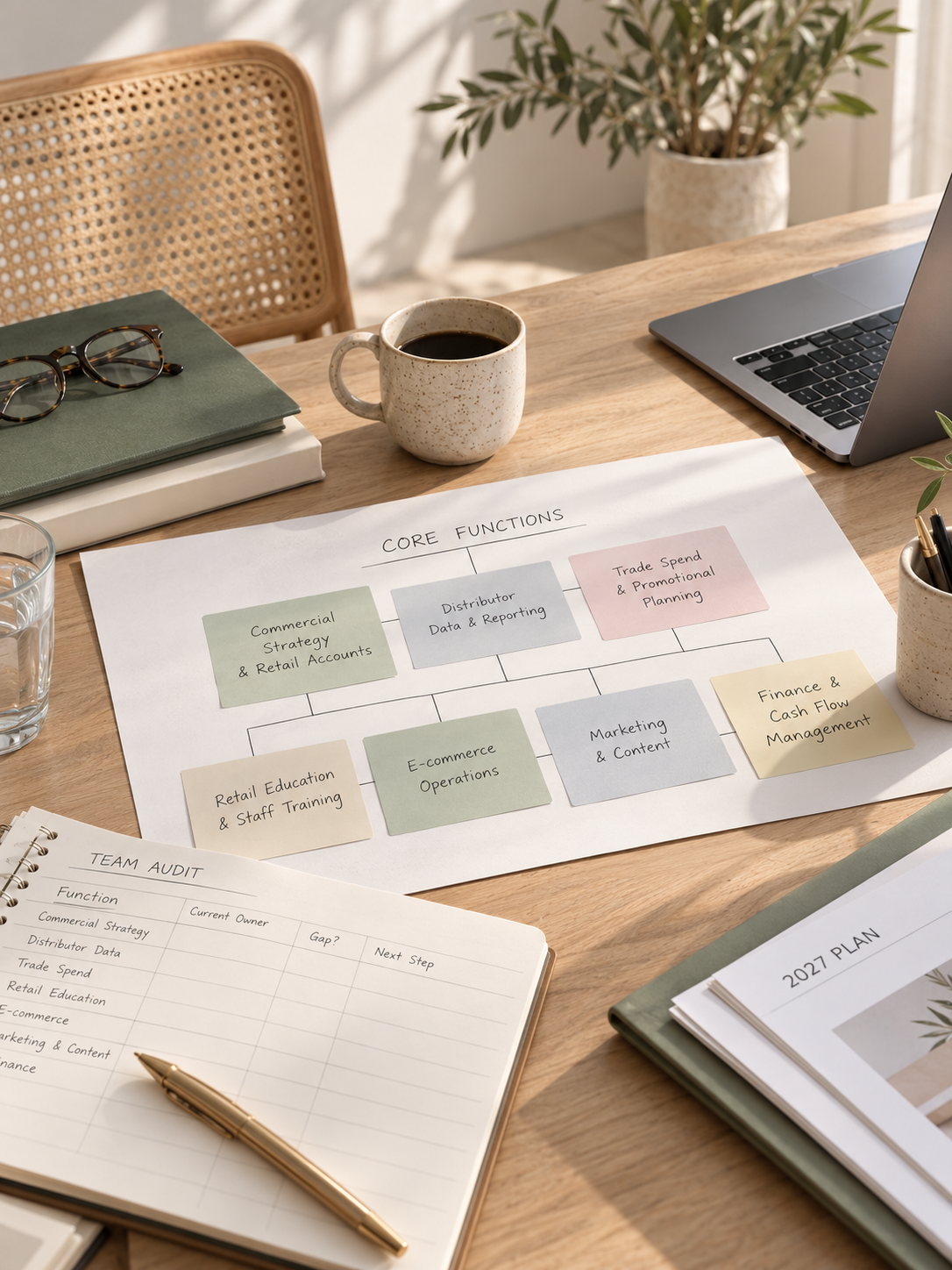
Functions a Natural CPG Brand Needs at This Stage
Not the people. The functions:
Commercial strategy and retail account management
Distributor data analysis and reporting
Trade spend management and promotional planning
Retail education and staff training
E-commerce operations (Shopify, Amazon, DTC)
Marketing and content (social, email, website)
Finance and cash flow management
One person can cover two of those functions well. Maybe three if two are light. Nobody covers five. The decision: audit your team against the functions, not the org chart. Identify the gaps. Then decide whether to hire, outsource, or bring in fractional support for each one.
The brands that grow from $10M to $20M are the ones that figured out their functional coverage. The ones that stay stuck are usually the ones where the founder still runs the distributor relationship, the marketing hire also does customer service, and nobody owns data.
Score yourself across all five areas
Download the free 2027 Commercial Readiness Audit.
The Common Thread
All five of these decisions share one thing. They are not product decisions. They are not marketing decisions. They are operational and structural decisions that determine whether your product and marketing investments actually pay off.
You can launch the best new SPF serum in the natural channel. If nobody is tracking whether it is getting shelf space, measuring whether the launch promo worked, or catching the deduction errors on the introductory deal, you will not know how the launch actually performed until it is too late to fix it.
November is the right time to make these decisions. You still have eight weeks before 2027 starts. That is enough time to assign commercial leadership, set up a data cadence, build a promo measurement template, create a deduction review process, and audit your team structure.
None of this requires a massive budget. It requires clarity about who owns what.
Frequently Asked Questions
What is commercial infrastructure for a CPG brand?
Commercial infrastructure is the set of systems, processes, and roles that connect your product to revenue. It includes your commercial leadership model, distributor data systems, promotional measurement, trade spend accountability, and team structure. It is the operational layer between making a product and making money from it.
When should a natural CPG brand hire a fractional executive?
The typical inflection point is between $3M and $15M in revenue. Below $3M, the founder can usually manage commercial relationships directly. Above $15M to $20M, most brands need full-time senior leadership. In between, a fractional model gives you executive-level commercial strategy at 30% to 40% of the cost of a full-time hire.
How do I know if my distributor data is good enough?
Ask yourself four questions: Can you state your door count within 5% accuracy? Can you name your top and bottom three SKUs by velocity? Do you know your fill rate at each distributor? Can you compare this quarter's performance to last quarter's? If you cannot answer all four, your data infrastructure needs work.
What percentage of revenue should go to trade spend?
Industry benchmarks for natural CPG brands range from 15% to 25% of gross revenue. The exact percentage depends on your channel mix, retail partners, and growth stage. The more important question is whether you can measure the return on that spend. Untracked trade spend is the largest silent cost in most natural brands' P&Ls.
Planning 2027?
Beyond Business works inside natural beauty, skincare, and wellness brands as fractional commercial leadership.
<< Back to Beyond Business Blog